Data

Nuclear Masses in Astrophysics for the Next 25 Years
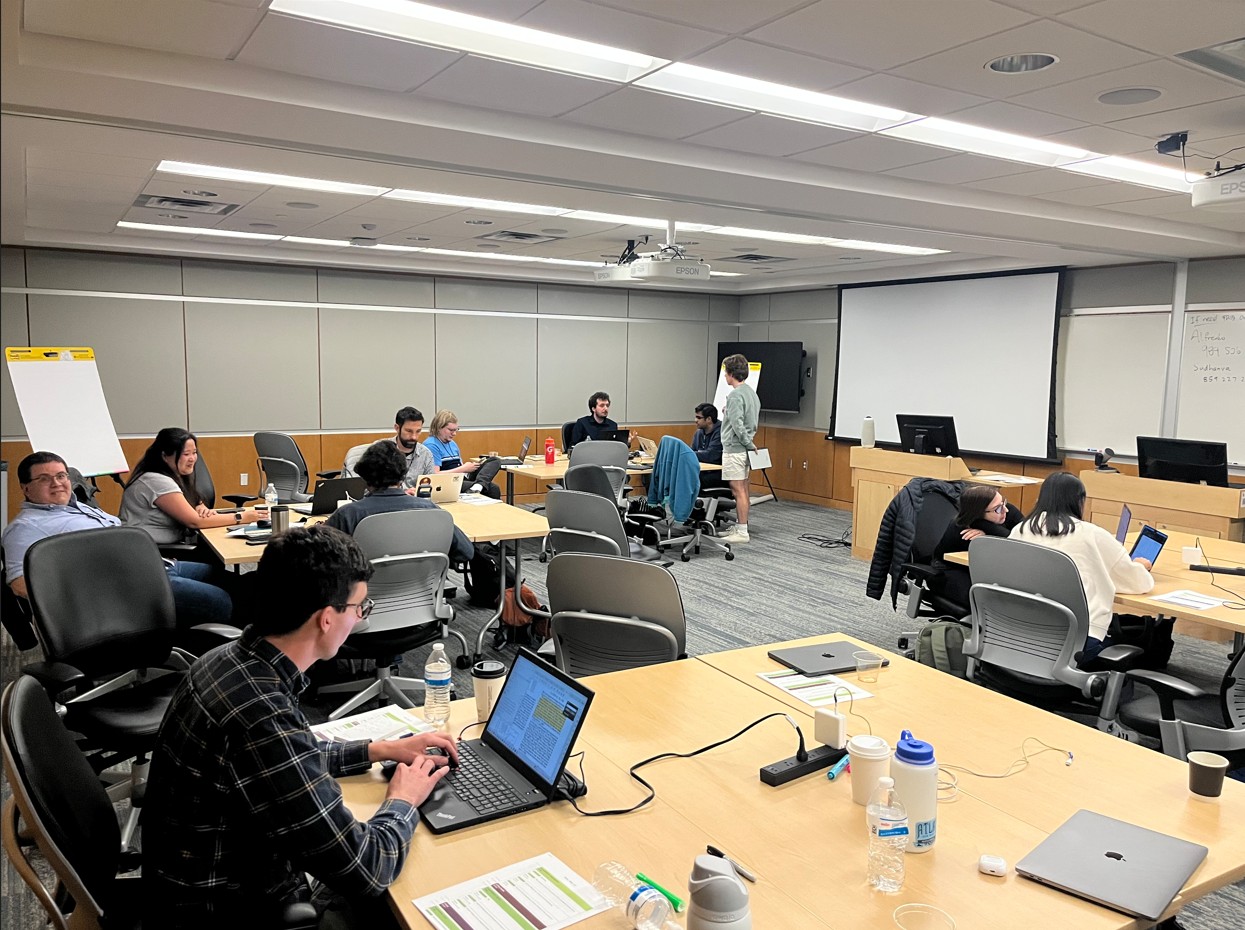
The Nuclear Masses in Astrophysics for the Next 25 Years workshop took place at MSU’s Facility for Rare Isotope Beams from March 11-13, 2026. Tthe workshop brought together scientists who are very interested on nuclear masses; experimentalists in the field of mass spectrometry, theoreticians that develop models to predict nuclear masses, and astrophysicists that need them as an input to their calculations of nuclear processes in extreme stellar environments.
As a result, a consensus opinion was formed: If we could only measure one property of an unstable isotope let that be its nuclear mass. On the one hand, the mass, through E=mc2, is a direct measure of the binding energy of neutrons and protons in an atomic nucleus. It encapsulates basic information about the structure of the nucleus, and is a key value to calculate rates for nuclear reactions driving nucleosynthesis processes in many astrophysical environments.
This workshop was the second meeting of a series that began in Darmstadt, Germany, in August 2025. The first Nuclear Masses workshop was attended by 50 scientists from around the world. Its program consisted of presentations that covered the broad field of research in nuclear masses and highlighted the work of early career scientists who took the center stage in the first two days of the meeting. The follow-up workshop at FRIB was attended by 22 scientists and was a focused event to outline and kick-start the writing of a White Paper; which will provide an overview and chart the path forward for research on nuclear masses and their role in addressing fundamental questions in astrophysics.
The conclusion of these meetings is that nuclear masses are at the center of a dynamic area of research, and are important for certain astrophysical questions with exciting recent developments and new scientific discoveries expected over the next decades. There will be plentiful opportunities for experiments as a new generation of radioactive isotope beam laboratories, such as FRIB, reach their full power and new facilities and techniques are developed, like the use of multi-nucleon transfer reactions at ANL and other laboratories. Mass measurements will reach regions of the nuclear chart where astrophysical models directly connect nuclear masses to observed r-process abundances, for example for rare-earth isotopes and at N=126 shell closure. New mass measurements will also provide a guide to theoretical nuclear models, which are finding novel ways to predict masses across the nuclear landscape for example by extending ab-initio calculations and carefully quantifying uncertainties of model extrapolations.