Data

What does it take to make the r-process? Lessons from collapsing white dwarfs and magnetar giant flares featuring Tetyana Pitik (UC Berkeley)
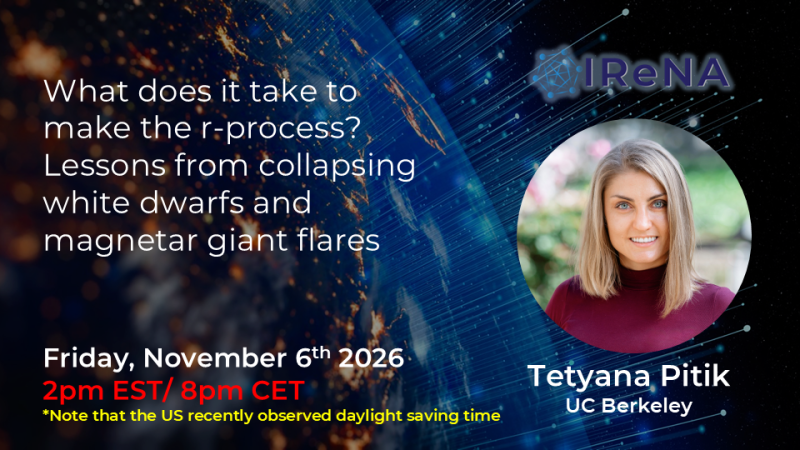
Hosted by: Luca Boccioli (TU Darmstadt)
Abstract: The kilonova of GW170817 showed that neutron-star mergers make r-process elements, but the abundances of the oldest stars and the discovery of long gamma-ray bursts followed by kilonovae suggest that other sites may contribute as well. Whether a proposed site can make heavy elements depends mostly on the thermodynamic conditions of the matter it expels. Determining them requires simulations that include general relativity, magnetohydrodynamics, neutrino and radiative transport, and a nuclear equation of state. In this talk I will follow two very different candidates, the collapse of magnetized white dwarfs and the crust ejection in magnetar giant flares, from the ejection of matter to its nucleosynthesis and to the signals we can observe. Comparing the two, I will discuss what really decides whether a site makes heavy elements, and which observations can tell us if it does.