Data

Nuclear physics constraints on the γ-ray signatures of core-collapse supernovae featuring Thanassis Psaltis (Saint Mary's University, Canada)
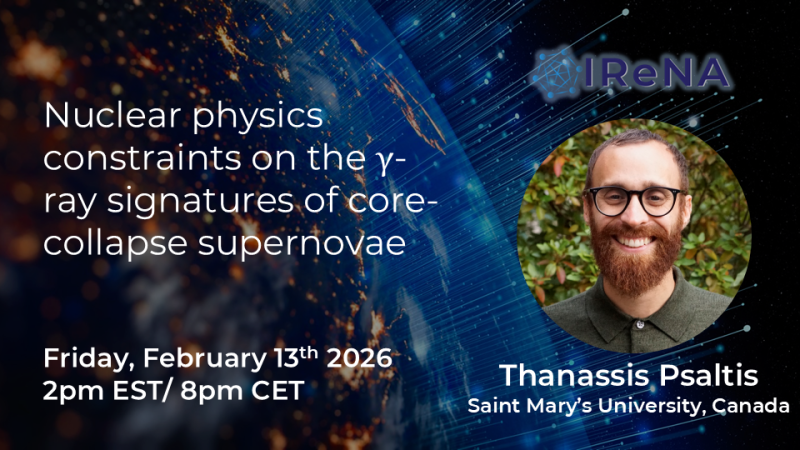
Hosted by: Artemis Tsantiri (University of Regina, Canada)
Abstract: The long-lived γ-ray isotopes observed in supernova remnants serve as direct signatures of the nucleosynthesis processes occurring deep within core-collapse supernovae. However, transforming these observations into a clear understanding of explosion dynamics requires precise nuclear physics input. A prime example is the 13N(α,p)16O reaction, which has been identified as a major nuclear uncertainty affecting the production of observable isotopes such as 44Ti and various neutron-rich iron-group elements.
In this talk, I will present a new measurement of the 13N(α,p)16O reaction cross section performed at the CRIB facility (RIKEN). By employing the thick-target inverse kinematics technique with a high-intensity radioactive 13N beam, we probed the astrophysically relevant energy range of Ec.m.≈1.2–5.0 MeV. I will discuss our experimental approach and share preliminary results from this campaign, illustrating how targeted nuclear physics measurements provide the critical data needed to refine nucleosynthesis models. These results are essential for improving the interpretation of current γ-ray data and enabling more accurate predictions for next-generation observatories, ultimately allowing us to use γ-ray signatures as detailed probes of stellar explosion physics.
References
[1] K. Hermansen et al., Astrophys. J 901, 77 (2020).
[2] S. Subedi et al., Astrophys. J 898, 5 (2020).
[3] C.L. Fryer et al., arXiv:2601.04464 [astro-ph] (2026).
[4] A. Meyer et al., Phys. Rev. C 102, 035803 (2020).
[5] H. Jayatissa et al., Phys. Rev. C 105, L042802 (2022).