Data

Chemical evolution of neutron-capture elements: a multi-objective approach featuring Marta Molero (TU Darmstadt)
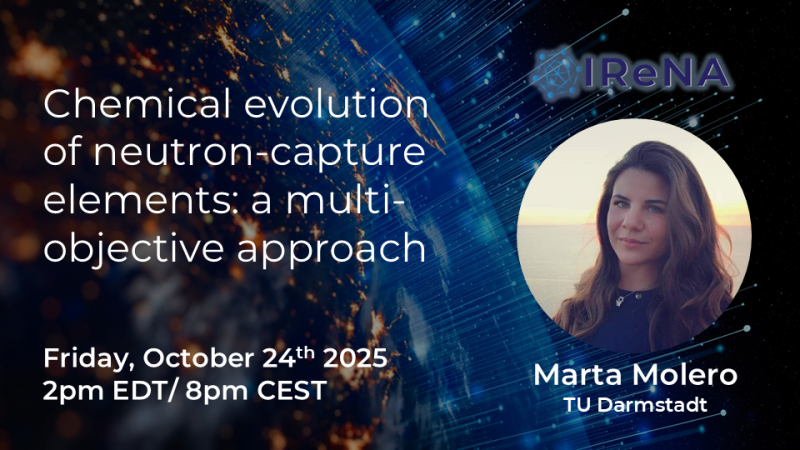
Hosted by: Linda Lombardo (INAF Trieste)
Abstract: The origin of the heavy elements produced by neutron-capture processes remains one of the central open questions in astrophysics. Two main channels have been identified: the slow neutron-capture process (s-process), operating primarily in asymptotic giant branch (AGB) stars and rotating massive stars, and the rapid neutron-capture process (r-process), whose astrophysical site(s) are still debated. Additional contributions from an intermediate neutron-capture process (i-process) may further shape the observed abundance patterns, especially at low metallicity. Galactic chemical evolution (GCE) models provide a powerful framework to constrain these properties by comparing predicted and observed abundance trends of neutron-capture elements across metallicity. In particular, at later stages of Galactic evolution, when the chemical environment becomes progressively more homogeneous, the chemical pattern observed in any given star is no longer a direct imprint of a single enrichment event and homogeneous GCE models are required to disentangle the relative role of the different nucleosynthetic channels. In this talk, I will discuss both the classical GCE approach, which combines prompt and delayed stellar sources, and a more flexible, site-independent framework based on a large grid of parametric models varying key r-process parameters. By comparing model predictions with observations of light and heavy neutron-capture elements, I treat the problem as a multi-objective optimization, where each element provides an independent observational constraint. I will present both the best-fit models and the Pareto-optimal solutions, highlighting the trade-offs between different elements and the regions of parameter space most consistent with the different elemental abundance ratios. I will overall discuss the broader implications for understanding the origin of heavy elements, focusing on the frequency and delay of neutron star mergers, the need for at least one rapid early source, and the question of whether the r-process is universal across astrophysical environments.
Orchid Link: https://orcid.org/0000-0002-8854-6547