Data

2026 CeNAM Frontiers in Nuclear Astrophysics Conference
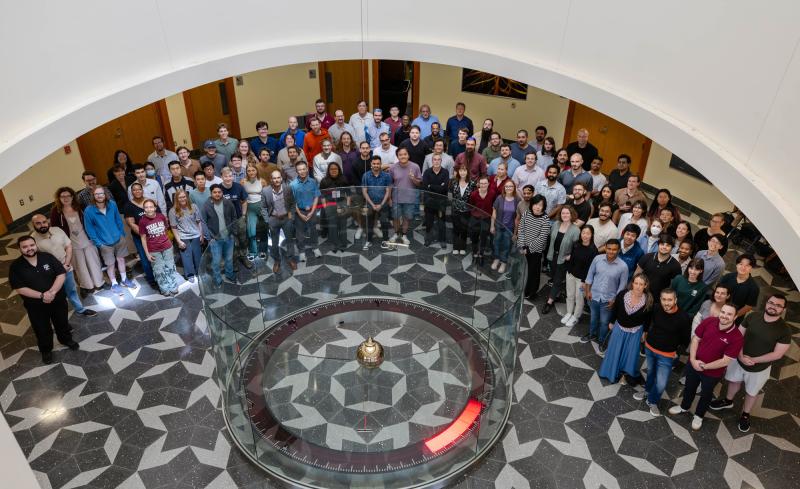
*Originally posted by Texas A&M University College of Arts & Sciences News on July 7, 2026
The 2026 CeNAM Frontiers in Nuclear Astrophysics Meeting was held May 18-22 at Texas A&M University, co-hosted by the Cyclotron Institute and Department of Physics and Astronomy.
Roughly 130 international nuclear physicists and astrophysicists gathered to share their latest work and collaboration ideas while forging connections and the future of nuclear astrophysics. The annual event, which included a two-day junior workshop for graduate students and postdoctoral researchers, featured dozens of invited speakers and workshop presentations on recent advances and emerging frontiers, faculty and industry career panels, a poster session and guided tours of the Cyclotron Institute.
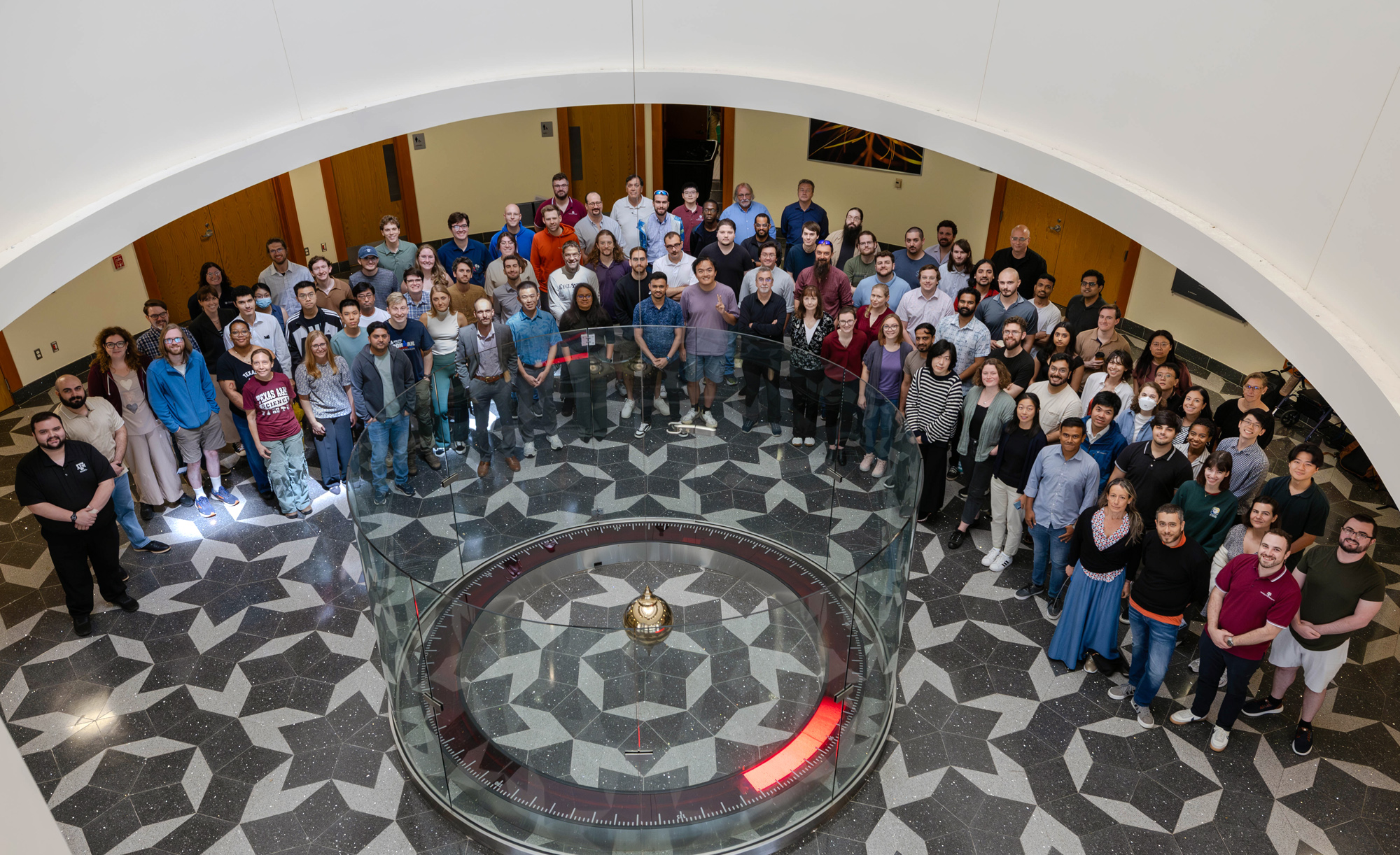
Texas A&M graduate students John Dixon and Anthony Lestone served as co-chairs for the Frontiers 2026 organizing committee, which also included Khanak Bhargava (Stony Brook University), David Friedenberg (TAMU), William Hatano (University of São Paulo), Mengke Li (UC Berkeley), Guilherme Limberg (University of Chicago), Óscar López (National Autonomous University of Mexico), Eilens Lopez Saavedra (ANL), Kelsey Lund (UC Berkeley), Ruijie (Jay) Shi (University of Florida), Kaitlin Webber (TAMU), Guruprasad Yagadevan (Politechnika Wrocławska), Muhammad Asif Zubair (Mississippi State University). Texas A&M faculty Dr. Jennifer Marshall and Dr. Philip Adsley served as committee advisors.
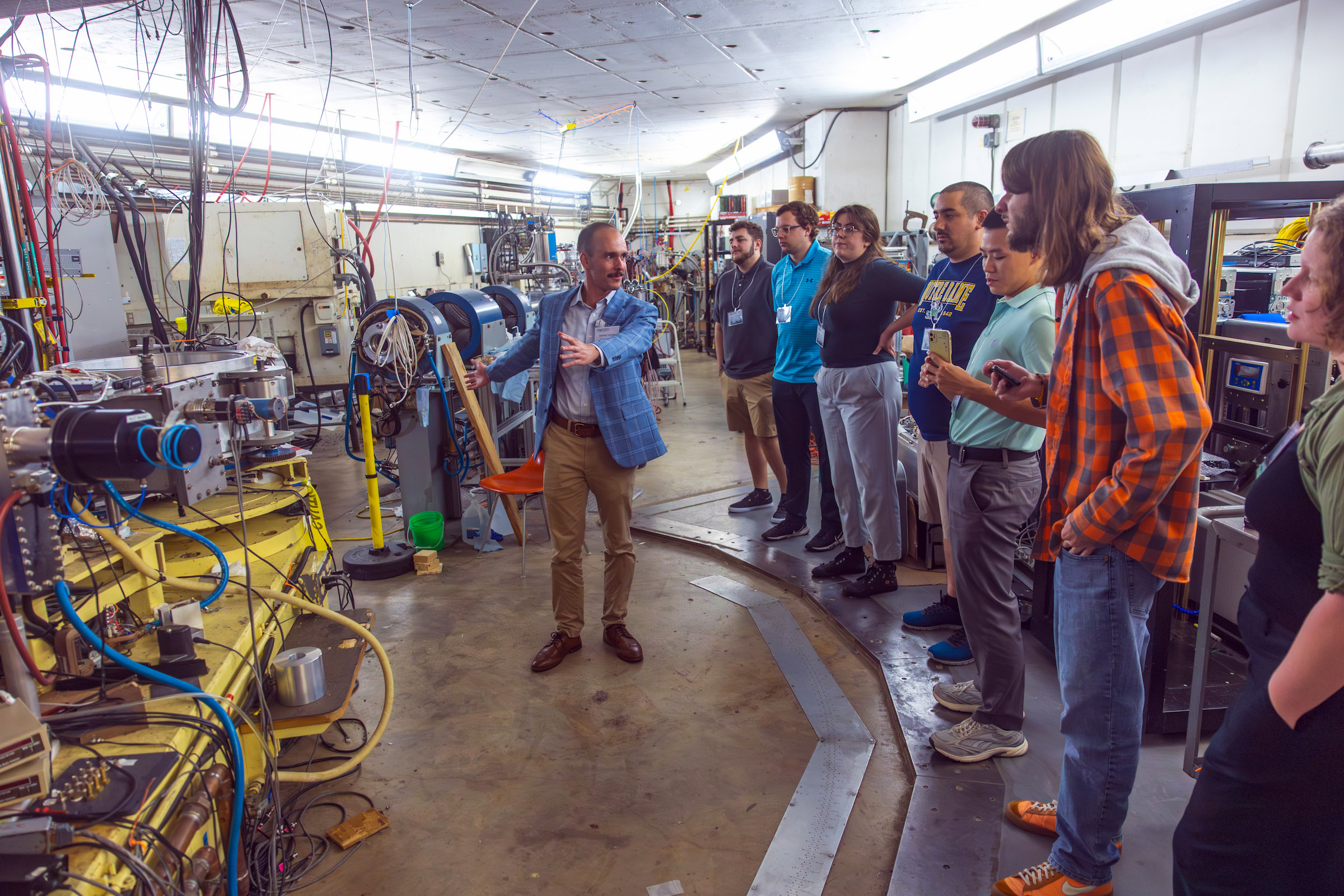
Texas A&M physics graduate student Anthony Lestone (left) leads CeNAM Frontiers 2026 attendees in a tour of the Cyclotron Institute. | Image: Chris Jarvis, Arts & Sciences Marketing & Communications
When Opportunity Knocks
For Dixon and Lestone, a journey that began nearly a year ago with understandable reservations as they plunged headlong into the unknown of event planning ultimately gave way to a newfound sense of humble accomplishment and gratitude — a byproduct of their collective decision to embrace their opportunity to serve when it came along, disguised as extra work neither one needed.
"This conference kind of consumed my life for the past six months, which was exhausting but extremely fulfilling,” said Lestone, a nuclear physicist who was also simultaneously planning his June 20 wedding. "I had no preconceived notions, but I now have an appreciation for just how much work goes into conference planning. Being there and seeing all the work you put in come to fruition … it’s an indescribable feeling.”
Dixon, whose research focuses on stellar astrophysics, similarly summed it up as a rewarding experience that taught him many new skills, from organizational to interpersonal, along with a crash course in crisis management.
“That first day, I was so worried,” he recalled. “I didn’t get much sleep the night before. And then on day three, we made the decision to move to a hybrid format because of heavy storms across Texas that cancelled a lot of flights into College Station. It was a stressful situation, but once each day started and the first session ran smoothly, I was able to breathe a sigh of relief.”
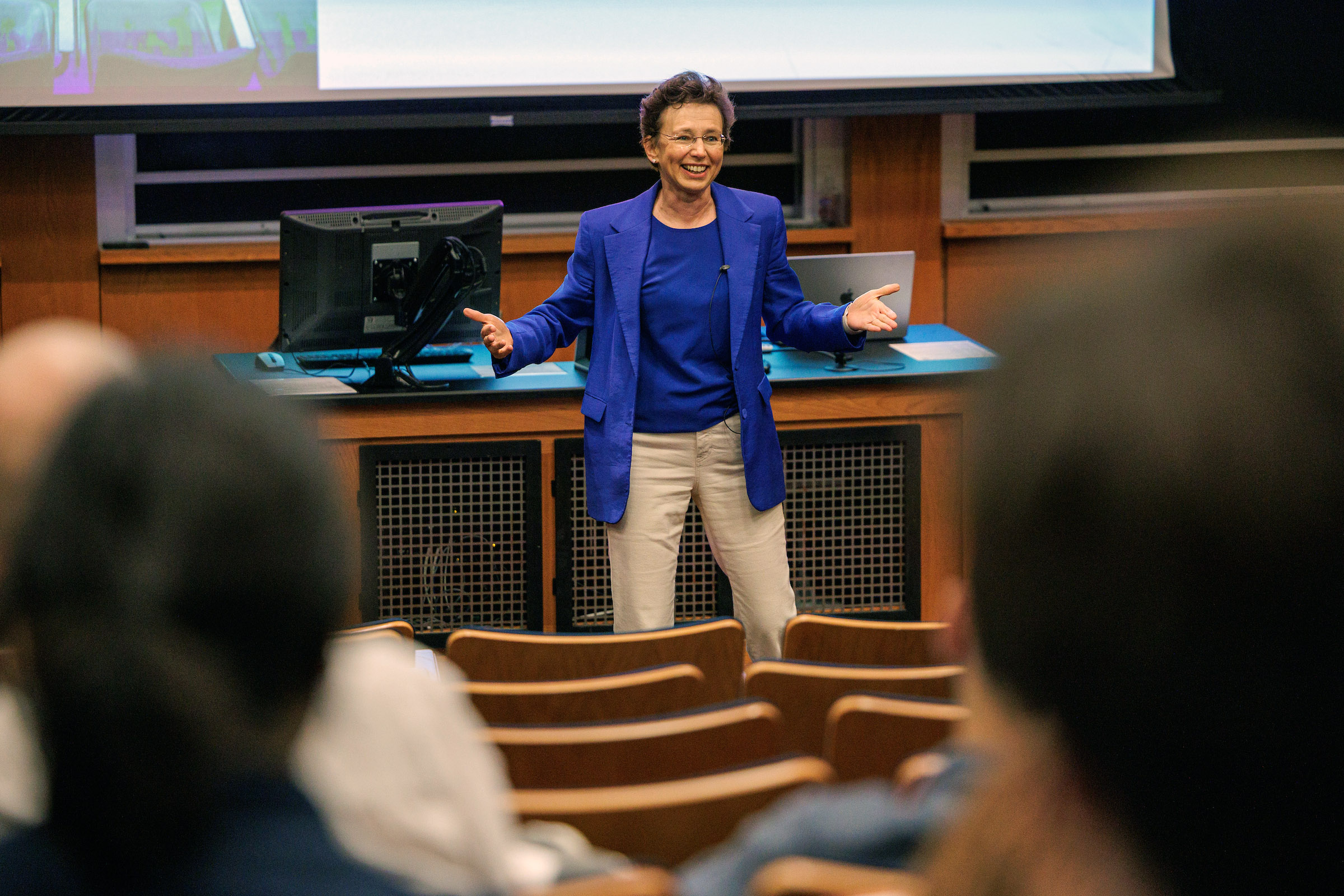
As a junior workshop guest lecturer, Texas A&M physicist and Presidential Professor for Teaching Excellence Dr. Tatiana Erukhimova shared best practices for teaching and inspiring students through her personal approach to the business of science education. Both John Dixon and Anthony Lestone know the value first-hand as mentors for DEEP (Discover, Explore and Enjoy Physics and Engineering), one of several innovative programs created by Erukhimova to help integrate science education with outreach engagement and community service. | Image: Mathew Baughman, Arts & Sciences Marketing & Communications
By virtue of their leadership roles and responsibilities, Dixon and Lestone said they got less of the typical conference attendee experience they’d come to expect. However, that less turned out to be more, in serendipitous ways for both.
“I handled the majority of the correspondence, while Anthony took on most of the logistics,” Dixon explained. “As people started to arrive, I was able to put faces with the names I’d been emailing with for months, which was nice. One hundred thirty people, and they’re all doing great work, and they couldn’t exist without each other.”
In Real Life Gets Real
Lestone agreed that making personal connections was a major highlight, if not an unexpected perk well worth giving up one’s usual breaks in the conference action to field participant questions and take care of behind-the-scenes duties on the fly.
“The conversations would start with a logistical question, then lead to us discussing research,” Lestone added. “It was fun getting to meet so many people I’ve only seen on Zoom calls or as authors on papers.”
“Or as citations on posters,” Dixon interjected. “During the poster session, I received questions from professors whose research directly inspired mine, which was intimidating and a bit surreal. Being an organizer gave me a little more courage to talk to some of these senior researchers. Having that title sort of breaks the ice.”
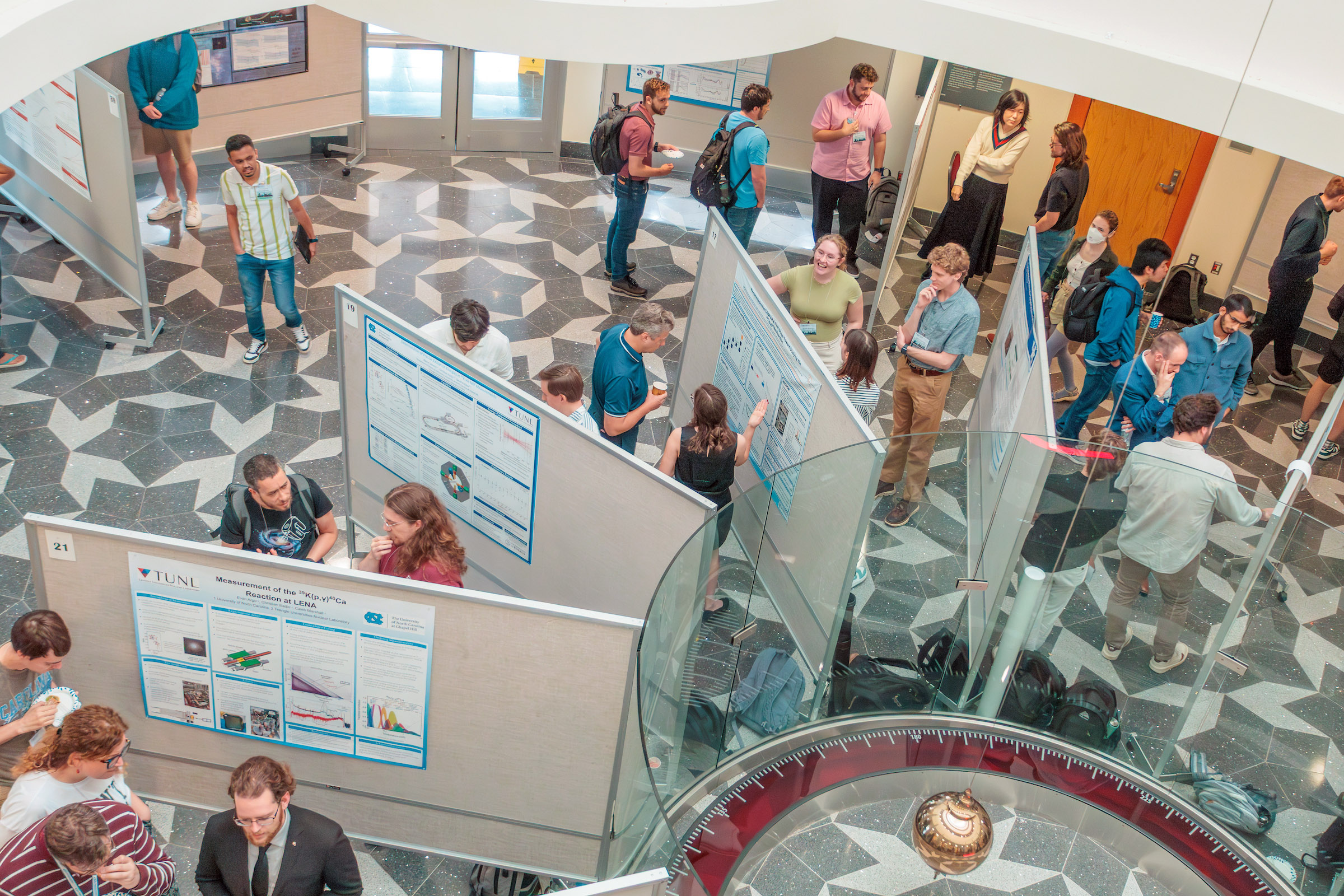
Graduate students present their research during the CeNAM Frontiers 2026 poster session in Penrose Plaza within the George P. and Cynthia Woods Mitchell Institute for Fundamental Physics and Astronomy. | Image: Olivia Hearne, Arts & Sciences Marketing & Communications
In addition to meeting and networking with some of the biggest names in their field, both students also enjoyed the opportunity to learn more about each other’s respective work and that of their graduate student peers.
“I learned a lot of astronomy that I would not have otherwise learned outside of this conference," Lestone said. “I was also impressed with the quality of the junior talks. It was really motivating to see such great work coming from fellow students.”
“As an astronomer, Frontiers is my main exposure to nuclear theory and experimental research,” Dixon added. “There aren’t a lot of conferences like this with a wide range of people working toward the same goals from different directions. It was also the first time in Texas for a lot of the attendees. It was an honor to host the event here at Texas A&M and to give people the opportunity to see the depth and breadth of research being done here. I think it was eye-opening for a lot of them and really satisfying for us.”
Embracing The Unconventional
One of the programming highlights for both students was a concept unique to CeNAM: unconferencing sessions that offer the flexibility to cover topics outside the expected research-related norms, followed by small-group discussions and a concluding summary session.
“I chose to talk about improving accessibility and how we could better involve and support people with disabilities,” Dixon said. “The topics have to be within reason, but the variety and the broader conversations around them are always interesting and inspiring.”
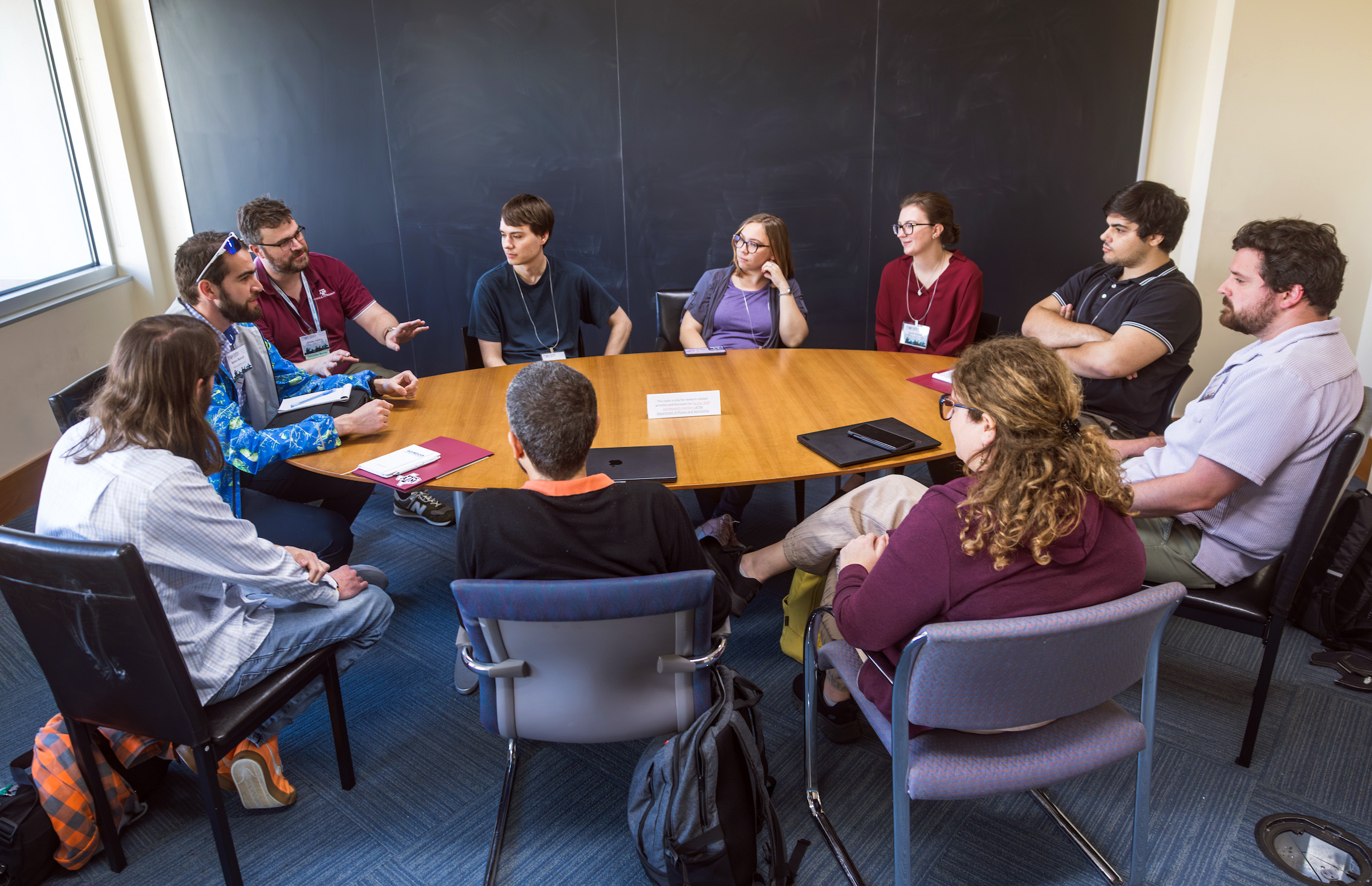
Texas A&M physicist Dr. Philip Adsley (third from left, wearing maroon) leads a group breakout discussion following the CeNAM Frontiers 2026 unconferencing session, a hallmark of the annual event. | Image: Chris Jarvis, Arts & Sciences Marketing & Communications
With their conference planning experience relegated to the recent past, Dixon and Lestone said they are gratified by the feedback, which has been mostly positive, and the knowledge that they are part of an extremely engaging community dedicated to preparing and uplifting next-generation leaders in nuclear science with career impact that transcends research.
“Near the end of the conference, I was talking with a fellow graduate student about how sometimes, you find yourself alone in the office at 9 p.m. on a weekend,” Lestone said. “Graduate school can be hard, but we both agreed that events like this make it all worth it. They remind you why you do the work in the first place, and how much fun physics can be.”
Dixon agreed that some of the most memorable moments can’t be found on any conference schedule.
“As much as I enjoyed all the talks and related discussions, the human element was really my favorite part,” Dixon said. “Science is very much a human process.”
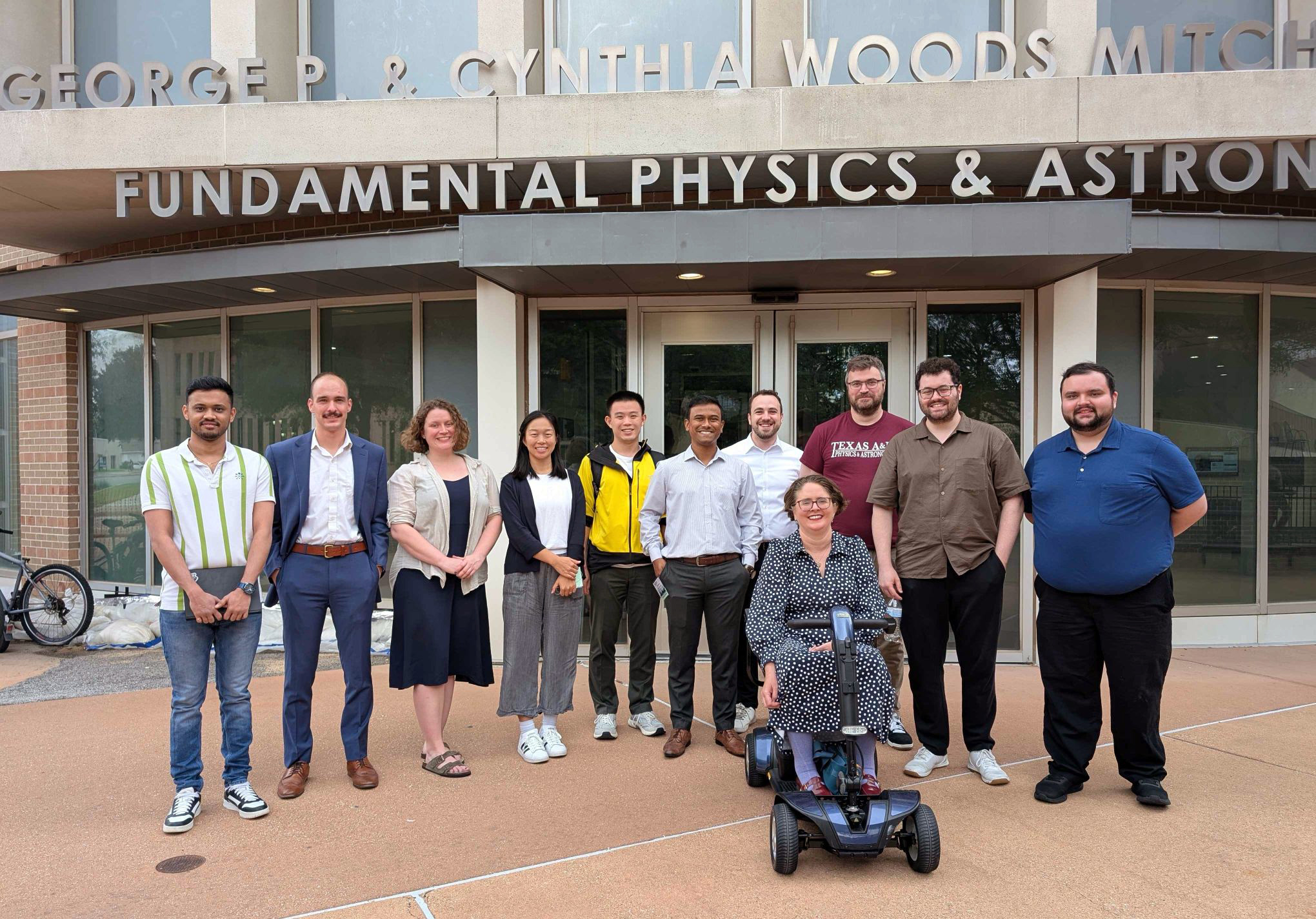
(From left:) CeNAM Frontiers 2026 planning committee members Guruprasad Yagadevan (Politechnika Wrocławska), Anthony Lestone (Texas A&M University), Kelsey Lund (University of California, Berkeley), Mengke Li (University of California, Berkeley), Ruijie "Jay" Shi (University of Florida), Muhammad Asif Zubair (Mississippi State University), David Friedenberg (Texas A&M University), Dr. Jennifer Marshall (Texas A&M University), Dr. Philip Adsley (Texas A&M University), Guilherme Limberg (University of Chicago) and John Dixon (Texas A&M University) pose during a break in the conference outside the George P. and Cynthia Woods Mitchell Institute for Fundamental Physics and Astronomy. | Image: Courtesy
Frontiers 2026 was sponsored by CeNAM, the Cyclotron Institute and Texas A&M Physics and Astronomy, with additional funding provided by the European Physical Journal A and the WoodNext Foundation through the Cyclotron Institute Research Cluster on Nuclear Astrophysics (CIRCoNA) initiative.
See additional photographs from Frontiers 2026 or learn more about graduate programs in physics and astronomy at Texas A&M.